
Brother Guy Consolmagno, S.J.: Eyes Pointed Toward the Heavens With a Heart Rooted Firmly in the Classroom
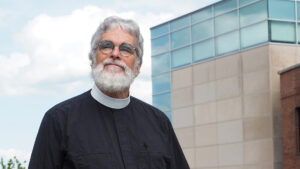
Vatican Observatory Director Brother Guy Consolmagno, S.J. is Teaching at Le Moyne College this Fall
As the Jesuit Scientist in Residence and McDevitt Visiting Scholar, Brother Guy will teach a course titled History of Planetary Science and deliver a public lecture.
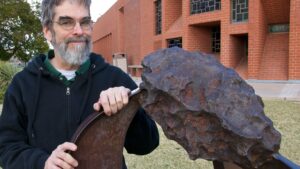
Brother Guy Consolmagno, S.J., has dedicated his professional life to studying the stars, glowing orbs of hydrogen and helium that Lord Byron called “the poetry of heaven.” Brother Consolmagno’s contributions to planetary science are extraordinary. He is an accomplished educator, researcher and author who has served at the Vatican Observatory twice – first as a staff astronomer and curator of its meteorite collection and later as its director. He is now director emeritus of the observatory, and is known in some circles as “the pope’s astronomer.” Highly respected by his peers, Brother Consolmagno is a Fellow of the Meteoritical Society and recipient of the American Astronomical Society’s prestigious Carl Sagan Medal. He even has an asteroid named in his honor, number 4597, a.k.a., Little Guy.
When asked why he revels in turning his attention to the sky, Brother Consolmagno says it is simple.
I study the universe today and spend my time explaining what my colleagues and I have found as a way of experiencing and sharing the joy of discovery. Underlying that motivation is the explicit realization that the joy I experience is a marker of the presence of God. I can recover the wonderful romantic reasons that drew me to this field in the first place.”
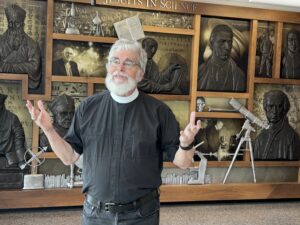
This fall Brother Consolmagno will bring his love of the planets to Le Moyne, where he will serve as a Jesuit Scientist in Residence and McDevitt Visiting Scholar. He will teach a course titled History of Planetary Science and deliver a public lecture. It will be a homecoming of sorts for Brother Consolmagno, who first arrived on the Le Moyne campus in 2009 as the Lanigan Chair in Science Medicine and Ethics.
A Michigan native, Brother Consolmagno says that his faith and religious vocation inform his work as a scientist and an educator. When he entered the Society of Jesus in 1989, he had already accrued nearly two decades of experience as a planetary science researcher and university professor. Today when he stands at the front of a classroom, his approach is not merely to teach his students a string of facts about the stars and planets, but to help them understand what to do with that knowledge, and to consider how it affects their understanding of who they are and what their responsibility is to the world around them. Likewise, he believes that what people call critical thinking is “useless if they don’t have reliable data to assess, or a rigorous context of assumptions and goals to guide where they are trying to go with that thinking.”
The Joy of Discovery
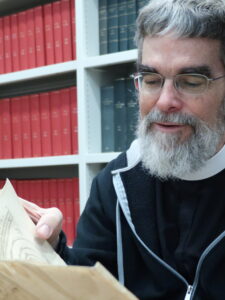
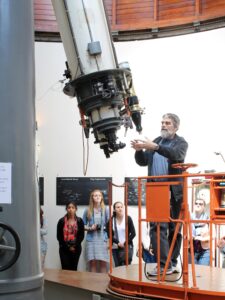
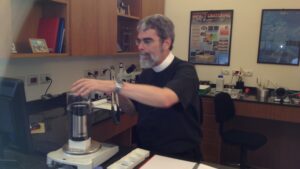
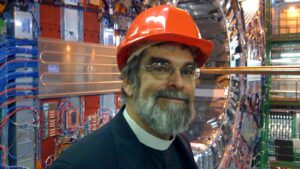
“One passage I find myself going back to again and again is Chapter 38 of the Book of Job. When the Lord speaks to Job out of the whirlwind and asks him, ‘Where were you when I set the foundation of the universe? Do you know the way to the dwelling of light?,’ I read that not as a reproval of Job for his arrogance — because in fact Job has been anything but arrogant — but rather a reproval of Job for not being brave enough to accept God’s invitation to look at the universe. It’s only by looking at the universe that we can appreciate its Creator, after all.”
“Even in a descriptive science like astronomy, the human element can never be forgotten,” he says. “And by observing ourselves as we learn, we can learn about how we learn and indeed how we come to know anything. That is the human philosophy behind the liberal arts and the tool we need to recognize and learn about our Creator.”
At the core of Brother Consolmagno’s instruction is his firm belief that a Jesuit education, in addition to being useful, must also nurture individuals to become men and women for others, individuals who are capable of growing into the people God created them to be.
“What I want to instill in students is joy: the joy of knowing, the joy of learning, and the joy of knowing how to learn more,” he says. “I know from many years of teaching and public speaking that the first lesson any listener takes away is the enthusiasm, or lack of enthusiasm, that the speaker has for the material being taught. You expose them to the love of the material and how each student can uniquely make that material their own.”
Dean of the Carroll College of Arts and Sciences Travis Newton, Ph.D., says that having this accomplished scientist and astronomer on campus, who is also deeply committed to Le Moyne’s Catholic, Jesuit mission, is a boon to the College and the surrounding community.
Having Brother Guy on campus brings new insight and energy to one of our most exciting emerging programs – astronomy.”
For his part, Christopher Bass, Ph.D., associate professor and chair of the Department of Physics, says that he is excited to see students interact with Brother Consolmagno as someone who “embodies scientific excellence and the Jesuit tradition” and possesses “a remarkable ability to communicate complex scientific ideas in ways that are accessible, engaging, and connected to broader connections of meaning and purpose.” Bass believes that Brother Consolmagno’s presence will “enrich conversations about science, faith, ethics and the role of curiosity in a liberal arts education.” What’s more, Bass says that the timing of Brother Consolmagno’s arrival on campus is fortuitous. He has observed a growing interest in astronomy among Le Moyne’s students, which he credits in part to the extraordinary discoveries over the past decade, including exoplanets, black holes, and the images and data coming from the James Webb Space Telescope.
I think astronomy naturally appeals to students because it addresses fundamental questions about our origins and our place in the universe. At Le Moyne, that interest has been strengthened by expanded course offerings, public observing opportunities, and undergraduate research experiences. Brother Guy’s residency will undoubtedly build on that momentum and inspire even more students to engage with astronomy and space science.”
Brother Consolmagno continues to be a student himself. He is particularly energized by things that have transformed the way human beings understand the planets. To that end, he finds it instructive and fun to look at our past history of revolutionary discoveries to see what we did right and wrong. More than anything else, he also finds it informative, and sacred, simply to turn his gaze to the night sky.
I never grow tired of looking at the stars. Just looking. It’s fun to have a telescope, but not necessary. It does make the experience richer to have a history of the people whom I loved, from my father to my fellow astronomers, who taught me what to look for, so that when I see a familiar sight in the sky now, I can associate it with a wonderful memory of a time, and a place, and a person.”
At a Glance
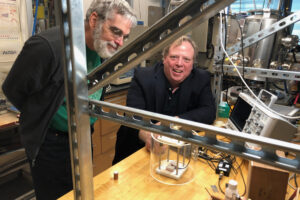
About Brother Guy Consolmagno, S.J.
Education:
B.S. Planetary Science – Massachusetts Institute of Technology, 1974
M.S. Planetary Science – Massachusetts Institute of Technology, 1975
Ph.D. Planetary Science – University of Arizona, 1978
Memberships:
International Astronomical Union (since 1994)
Member, Working Group on Planetary System Nomenclature
Chair, Mars Nomenclature Task Group
American Astronomical Society Division for Planetary Sciences (since 1994)
Chair, Division for Planetary Sciences (2007 term)
Meteoritical Society (since 1994)
President (2025-2026)