
Le Moyne Professor Awarded NASA Grant for Research to Investigate Ancient Asteroids
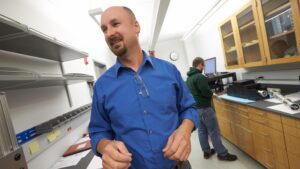
Dr. Christopher Bass, associate professor of physics, has been awarded $309,000 in funding through NASA’s competitively selected Mentorship and Opportunities in STEM with Academic Institutions for Community Success (MOSAICS) program. His research project, titled “Investigating the Basaltic Nature of Newly-Identified V-Type Asteroids by the Gaia Survey,” will explore the origins of rare volcanic asteroids using data from NASA’s Infrared Telescope Facility (IRTF) in Hawaii. With over 20 submissions, Le Moyne was one of only eight colleges and universities in the nation selected for this funding.
In collaboration with Dr. Driss Takir, planetary scientist with the Astromaterials Research and Exploration Science (ARES) Division at NASA’s Johnson Space Center, Bass and his student research team will study the mineral composition of 24 V-type asteroids recently identified by the European Space Agency’s Gaia mission. These basaltic asteroids may preserve clues to the formation of the early solar system and help scientists understand whether multiple differentiated planetary bodies once existed beyond the well-known asteroid Vesta.
“This project represents a major step forward for Le Moyne’s growing astronomy program,” said Bass. “The NASA MOSAICS award gives us access to world-class facilities and expertise – and more importantly, gives our students a direct pathway into space science.”
Starting during the fall 2025 semester, over the two-year project Le Moyne students will conduct observations using the SpeX spectrograph at the NASA IRTF, analyze infrared spectra with state-of-the-art software, and compare asteroid compositions to known meteorite samples. Students will also engage in summer research experiences, including travel to the NASA Johnson Space Center in Houston for hands-on training and mentorship. The project culminates with students presenting their findings at a national scientific conference and contributing to a peer-reviewed publication.
The award not only enhances research capacity at Le Moyne, a primarily undergraduate institution, but also supports student engagement in NASA-aligned STEM careers – particularly for first-generation college students and those who may not otherwise benefit from a career-relevant experience to perform cutting-edge research in NASA-relevant fields in an environment where mentorship is recognized, encouraged and valued.
“This collaboration with NASA provides invaluable experience for our students and elevates Le Moyne’s role in space science research,” said Le Moyne Provost Jim Hannan. “We are thrilled to see Dr. Bass’s work recognized and supported at the national level.”
The MOSAICS Seed Funding program is designed to empower under-resourced institutions to establish new NASA collaborations and create research pipelines that actively develop the future STEM workforce. For more information about Le Moyne’s physics and astronomy programs, visit lemoyne.edu/physics.
