Vatican Observatory’s JOE Program Provides Le Moyne with World-Class Astronomical Observing and Research Opportunities
Le Moyne has been selected as one of only four Jesuit institutions that are inaugural participants of the Jesuit Observatory Experience (JOE), a new initiative of the Vatican Observatory. The JOE program provides students and faculty with opportunities to use the Vatican Advanced Technology Telescope (VATT), located in Arizona, for astronomical observing and research.
JOE gives participants experience with professional astronomical observing, while strengthening connections between institutions and the Vatican Observatory. Through the program, Le Moyne will have access to the VATT, a 1.8-meter research telescope operated by the Vatican Observatory at the Mount Graham International Observatory in Arizona. Le Moyne is one of only four Jesuit institutions currently participating in JOE, along with Georgetown, Fordham and Creighton.
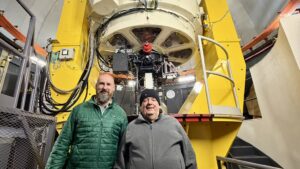
As part of the initial implementation of the program, physics Associate Professor Christopher Bass recently traveled to the VATT for training in the telescope’s operation and observing systems. During the visit, Bass worked with Paul Gabor, S.J., vice director of the Vatican Observatory to learn how the telescope operates and gain hands-on experience with its remote-control capabilities. This training prepared Bass to operate the VATT remotely from Le Moyne’s campus, establishing the foundation for the College’s participation in professional astronomical observing through JOE. Bass is shown above with Father Gabor at the VATT.
“The goal of JOE is to provide students with an opportunity to engage in authentic astronomical research, including planning observations, acquiring data with a professional research telescope, and reducing and analyzing those data,” said Bass. “Once fully developed the program will provide a rare and unique opportunity for undergraduate students to gain hands-on experience with professional astronomical research. As the College develops its observing program, the VATT will provide a resource for engaging undergraduate students in observational astronomy and planetary science.” According to Bass, one planned research direction involves measuring asteroid light curves, which track changes in an asteroid’s apparent brightness over time. By analyzing these variations, astronomers can determine rotation periods and investigate physical properties such as asteroid shape and rotational behavior. This work will complement broader research into asteroids and other small bodies in our Solar System.
The involvement of Le Moyne in the program coincides with the return to campus of Brother Guy Consolmagno as Jesuit Scientist in Residence and McDevitt Visiting Scholar. (He spent the fall 2009 semester at Le Moyne as the Lanigan Chair in Science Medicine and Ethics.) Now the director emeritus of the Vatican Observatory (he was director from 2015 to 2025) he is the second Vatican Astronomer to be a faculty member at Le Moyne, joining George Coyne, S.J., who was the McDevitt Chair of Religious Philosophy from 2012 until his passing in 2020. He came to the College following serving as director of the Vatican Observatory for 28 years.
“We’re delighted to have Le Moyne as one of the first schools to take part in this new program, especially given its historic connection with the Vatican Observatory through the late Father George Coyne,” said Brother Consolmagno. “In fact, the astronomy students at Le Moyne are an ideal cross-section of the sorts of students we hope to reach – curious and eager. We don’t expect them to go on to be professional astronomers… but then, who knows?”
“This initiative underscores the importance of experiential learning as a fundamental tenet of Jesuit education,” said Le Moyne President Linda LeMura. “We hold deep reverence for the significance of the physical sciences as an original component of the ‘Ratio Studiorum’ or ‘Plan of Studies’ in Jesuit education. The study of the physical sciences invokes awe and wonder in the beauty of the natural world and reveals the Jesuit ethos of ‘Finding God in All Things.’ ”