

What Does a Jesuit Education Really Mean?

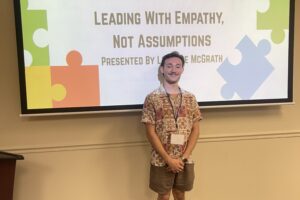
Let’s be honest—when you first applied to Le Moyne, you probably heard President Linda LeMura and others praise the impact of a Jesuit education. But what does that actually mean? We asked Legende McGrath ’26 to share his thoughts.
As many students get involved in leadership, attend retreats, or take part in service opportunities, the phrase Jesuit values comes up often. For some, it’s second nature (especially if you came from a Jesuit high school) but for others, it’s a fair question that even I didn’t fully understand until I became involved in student leadership. So, let’s break it down and explore why these values truly matter.
Jesuit Values for Every Path and Every Person
Cura Personalis means “care for the entire person.” It’s the idea that who you are matters more than what you produce. In other words, you are not a means to an end.
Professors take time to know your name, support your success, and prioritize your wellness and mental health. Reflection and self-awareness are encouraged so you can discover your identity, passions, and purpose.
At Jesuit institutions, you are not treated as a GPA or a statistic—you’re valued as a human being worth investing in.
Cura Personalis means “care for the entire person.” It’s the idea that who you are matters more than what you produce. In other words, you are not a means to an end.
Professors take time to know your name, support your success, and prioritize your wellness and mental health. Reflection and self-awareness are encouraged so you can discover your identity, passions, and purpose.
At Jesuit institutions, you are not treated as a GPA or a statistic—you’re valued as a human being worth investing in.
Magis doesn’t mean doing more work or being perfect. It’s about striving to become the best version of yourself.
Here’s what Magis is not:
- It’s not perfectionism. Instead, it’s about having a growth mindset: learning from your mistakes and improving your skills.
- It’s not burnout. Magis challenges you to find purpose, not exhaustion, in what you do.
- It’s not competition with others. Magis invites you to compete with who you were yesterday, to keep becoming the best version of yourself.
Through Magis, you learn to transform challenges into opportunities for reflection, growth, and excellence—not pressure.
Magis doesn’t mean doing more work or being perfect. It’s about striving to become the best version of yourself.
Here’s what Magis is not:
- It’s not perfectionism. Instead, it’s about having a growth mindset: learning from your mistakes and improving your skills.
- It’s not burnout. Magis challenges you to find purpose, not exhaustion, in what you do.
- It’s not competition with others. Magis invites you to compete with who you were yesterday, to keep becoming the best version of yourself.
Through Magis, you learn to transform challenges into opportunities for reflection, growth, and excellence—not pressure.
This value reminds us that true leadership is rooted in service. It’s a call to action to stand with, not above, others.
There are three main pillars of this value:
- Stand with marginalized communities
- Bring justice and compassion into daily actions
- Promote equity not as a trend, but as a responsibility
These pillars guide how we interact with the world around us. At Le Moyne, that might mean volunteering in Syracuse neighborhoods, organizing clothing drives, or advocating for social justice on campus. The point isn’t what kind of service you do. It’s that you do it with others, not just for them.
This value reminds us that true leadership is rooted in service. It’s a call to action to stand with, not above, others.
There are three main pillars of this value:
- Stand with marginalized communities
- Bring justice and compassion into daily actions
- Promote equity not as a trend, but as a responsibility
These pillars guide how we interact with the world around us. At Le Moyne, that might mean volunteering in Syracuse neighborhoods, organizing clothing drives, or advocating for social justice on campus. The point isn’t what kind of service you do. It’s that you do it with others, not just for them.
This one often confuses people, myself included when I first heard it. Some think “Jesuit” automatically means “Catholic,” but that’s not entirely true.
Jesuit education welcomes all faiths and worldviews: Muslim, Jewish, Christian, agnostic, and beyond. The emphasis is not on religious identity, but on ethical action and reflection.
Faith That Does Justice asks us to:
- Make ethical decisions that consider the common good
- Understand why we act, not just how we act
- Stand up for what’s right, even when it’s difficult
Ultimately, it’s about living your values through action, no matter your faith background.
This one often confuses people, myself included when I first heard it. Some think “Jesuit” automatically means “Catholic,” but that’s not entirely true.
Jesuit education welcomes all faiths and worldviews: Muslim, Jewish, Christian, agnostic, and beyond. The emphasis is not on religious identity, but on ethical action and reflection.
Faith That Does Justice asks us to:
- Make ethical decisions that consider the common good
- Understand why we act, not just how we act
- Stand up for what’s right, even when it’s difficult
Ultimately, it’s about living your values through action, no matter your faith background.
A Jesuit education doesn’t end when you graduate: it prepares you to engage with the world.
Whether you continue your education, work locally, or travel abroad, you carry with you a sense of global awareness and cultural understanding. Jesuit institutions challenge you to think beyond yourself: to approach other cultures, beliefs, and traditions with openness, curiosity, and respect.
Through this lens, you become a person capable of empathy, dialogue, and meaningful impact—no matter where life takes you.
A Jesuit education doesn’t end when you graduate: it prepares you to engage with the world.
Whether you continue your education, work locally, or travel abroad, you carry with you a sense of global awareness and cultural understanding. Jesuit institutions challenge you to think beyond yourself: to approach other cultures, beliefs, and traditions with openness, curiosity, and respect.
Through this lens, you become a person capable of empathy, dialogue, and meaningful impact—no matter where life takes you.
Take a Deeper Dive
Inspired by These Ideals?
As Legende shared, a Jesuit education is not just about earning a degree. It’s about growing into your fullest self. It teaches you how to think critically, act compassionately, and lead with purpose. At its heart, it’s about becoming a person for and with others, someone who sees the world not just as it is, but as it could be.
